Jackie Hudson from Nexo HR has continued to use the training services from Wendy Garrett of Garrett Learning since she established her business in 2020 for the PBSA sector:


Jackie Hudson from Nexo HR has continued to use the training services from Wendy Garrett of Garrett Learning since she established her business in 2020 for the PBSA sector:
Andrew attended the Mental Health First Aid programme to support his role as a walk leader for the CIC Men Walking and Talking group.
Garrett Learning are honoured and proud to support his group, find a walk near you: https://www.menwalkingandtalking.co.uk/
Woodie attended the Mental Health First Aid programme to support his role as a Breathwork facilitator and as a walk leader for the CIC Men Walking and Talking group.
Garrett Learning are honoured and proud to support his group, find a walk near you: https://www.menwalkingandtalking.co.uk/
Photography and video was created by the talented Maria Woziwoda: https://mariawoziwoda.co.uk/
Dawn Cullen, the Development and Quality Manager at Punch Pubs completed the Mental Health First Aider training and this is what she had to say about the training programme:
Rachel is the Business Support Analyst at Punch Pubs and she completed the Two-Day Mental Health First Aider programme with Wendy Garrett at Garrett Learning.
Take a listen to what she had to say about the training:

We are: Supportive – Curious – Welcoming – Encouraging – Straightforward. We are Garrett Learning.
Inside this month’s issue:
What’s been happening?
We’ve been having great conversations at a couple of conferences:
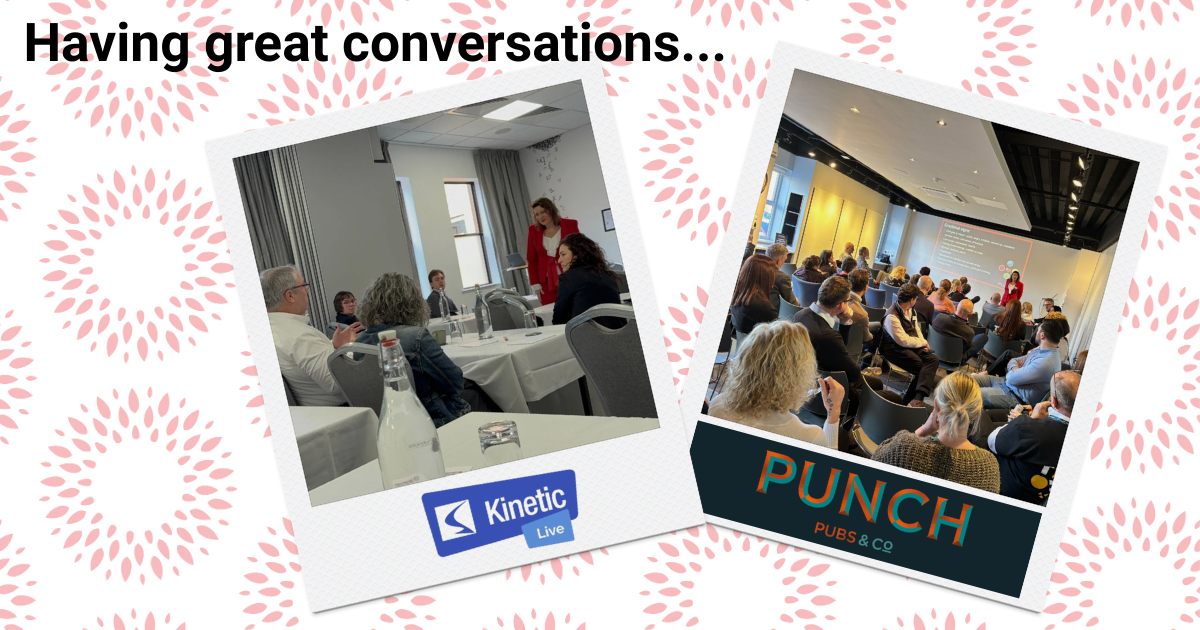
In February, we attended the East Midlands Conference Centre in Nottingham to speak at Kinetic Live for those working within the Student accommodation and Higher Education sector. We spoke about ‘Building safer, stronger teams’. We talked about workplace wellbeing, shared best practices, and actions we could take to look after the team and the students.
In March, we were invited to Punch Pubs & Co’s headquarters in Burton-Upon-Trent for their annual wellbeing day, ‘Doing well by doing good’. We had some fabulous conversations with the publicans, licensees and suppliers. There was a common theme throughout the day, which was ‘serve yourself first’. At Garrett Learning, we echo the importance of this message as it’s essential to ensure we look after ourselves before looking after others.
On a personal note, it was a great couple of events that complement my experience and background. It’s all come full circle.
At the age of 14, I started work as a waitress in a local pub, headed to Bournemouth University to study Licensed Retail Management, then went on to work in pubs, nightclubs and hotels in the UK, New York State and Australia, and more recently, volunteering at the local community cafe in Kidderminster. I regularly bring the community together at my local social club, including running a weekly poker league, plus various one-off events such as a charity night with a quiz, bingo, Play Your Cards Right, a massive raffle, disco and karaoke. In January, hubby and I designed an evening based around the TV show TaskMasters. Next up… a Traitor’s night!
In 2012, I retrained as a trainer/assessor, which later led me to work within the Student Accommodation sector at Liberty Living. We collectively developed the wellbeing and mental health strategy with the wider team.
It’s been great to bring all that knowledge and experience together and share it with other passionate people within the sectors.
We’re always happy to speak at events to share best practice, industry knowledge and the importance of looking after ourselves and our teams. Please do reach out if you’re looking for someone to speak, run a micro session or join a panel. Please send an email to wendy@garrettlearning.co.uk with the details.
What’s new?
For the last 18 months, Garrett Learning has been running monthly wellbeing sessions online to Mental Health First Aiders to support and embed their learning, as they aren’t required to refresh their knowledge until three years later. To me, this felt like a long time and I wanted to bridge the gap with some support, learning and growth.
Until last month, there has been a charge for this, however I have decided to offer it as a complimentary service to MHFAiders, wellbeing ambassadors, people managers and the HR team. Each month, we meet for 50 minutes. We’re having some great chats that could inspire so many others. We’d love you to join us when you can.
This week is Neurodiversity Celebration Week. It seems apt to share that our next Garrett Learning complimentary monthly support online check-in is all about Neurodiversity in the Workplace. We are joined by guest speaker Claire Elston (Chartered MCIPD), the founder of Elston HR Ltd.
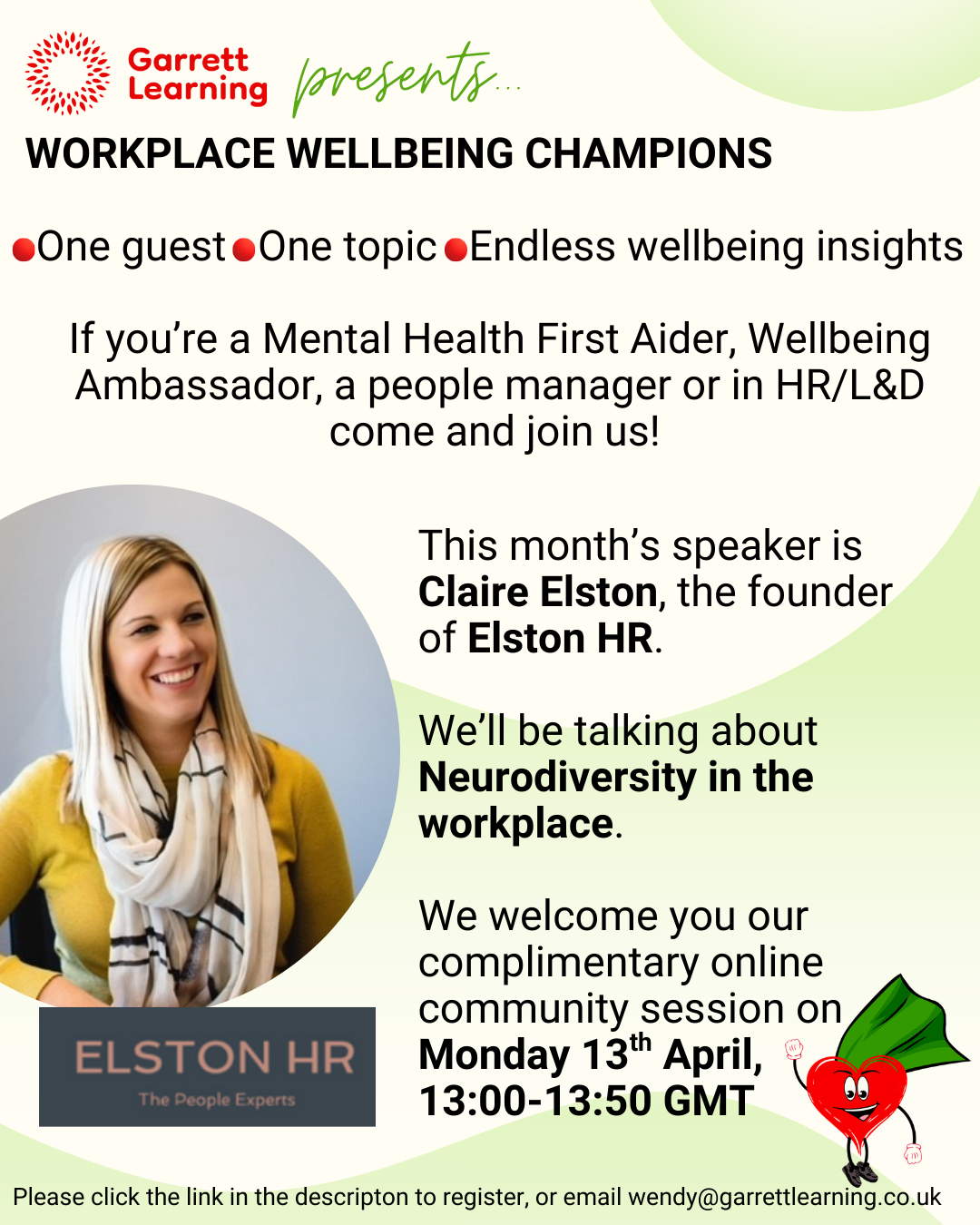
Claire is a values-driven HR consultancy dedicated to empowering organisations through people-focused solutions. At Elston HR they combine expertise in HR, coaching, training and leadership development with a deep understanding of the human factors that enable organisations to thrive. Specialising in HR, Management and Customer Experience, Claire has worked with national and multinational brands such as TUI, Eurocamp, Canvas Holidays, Premier Inn, and Harrison Clark Rickerby Solicitors. Claire supports businesses from multiple perspectives. As a generalist in HR with a specialism in training and development, Claire is particularly passionate about management training. She has recently been diagnosed with ADHD and is proud to deliver CPD-accredited Neurodiversity training to clients.
Claire will share some insights from this course to educate and empower us to create a more inclusive and supportive workplace for neurodiverse individuals.
The session is open to all Mental Health First Aiders, Workplace Wellbeing Ambassadors, People Managers, those in HR and L&D – Come and be a part of a wonderful complementary session by Garrett Learning and friends.
Want the zoom link – drop me an email at wendy@garrettlearning.co.uk
Future sessions will move to the second Wednesday of the month at 15:00 – 15:50 GMT and you’ll be able to register for these via this link: Register in advance for this meeting:
https://us02web.zoom.us/meeting/register/L830ddIxT-SPtI1VrgtxlA
After registering, you will receive a confirmation email containing information about joining the meeting.
We aim to offer alternate monthly sessions. We’ll either be joined by a guest speaker or have a drop-in session to ask any questions about workplace wellbeing, support for Mental Health First Aiders and wellbeing ambassadors, talk about boundary setting and get curious to learn more and make a difference together. Please note, these sessions are not for medical advice, counseling, or a therapy service.
If you have any questions or queries, please do reach out to me: wendy@garrettlearning.co.uk or Whatsapp: +447859 878 599
Find out more at: https://www.garrettlearning.co.uk/services/workplace-well-being-champion/
We look forward to welcoming you along.
What’s coming up?
Before we know it, it will be Mental Health Awareness Week. 11th to 17th May 2026. This year’s theme is Time for Action.
With the focus of looking after yourself, someone else and all of us.
We’d like to share three things you could do to take ‘Time for Action’:
For yourself:
The airplane analogy of ‘put your own mask on first’ is repeated, as it’s so important to look after ourselves before we can safely look after others.
Can you take a moment to pause and think about how you look after yourself? It’s self-care and it looks different for everyone and what we need changes over time.
Is there anything currently missing for you at the moment that you can introduce back into your life/routine to aid your wellbeing?
It doesn’t have to be a big and extravagant action; it could be something small and significant. For example:
Now the F1 season has restarted (and how good is it so far!!). This makes for a rested Sunday for me, no plans other than cooking a roast and settling in to watch the race with hubby (I do prefer an afternoon start time though!)
For someone else:
Taking action for others could include our family, friends, neighbours, colleagues and the people we pass in the street.
I recently read in a book titled ‘Make it Happen’ to smile at people in the street and see how it feels. Most of the time you’ll receive a smile back (if you don’t, that’s also ok). If you try this, see how you feel when you receive a smile. That’s taking action right?
I absolutely love Action for Happiness, https://actionforhappiness.org/ . Each month, there is a calendar. We’re currently in Mindful March (from memory, the theme for May is ‘Meaningful May’).
The calendar encourages a daily action either for yourself or for others.
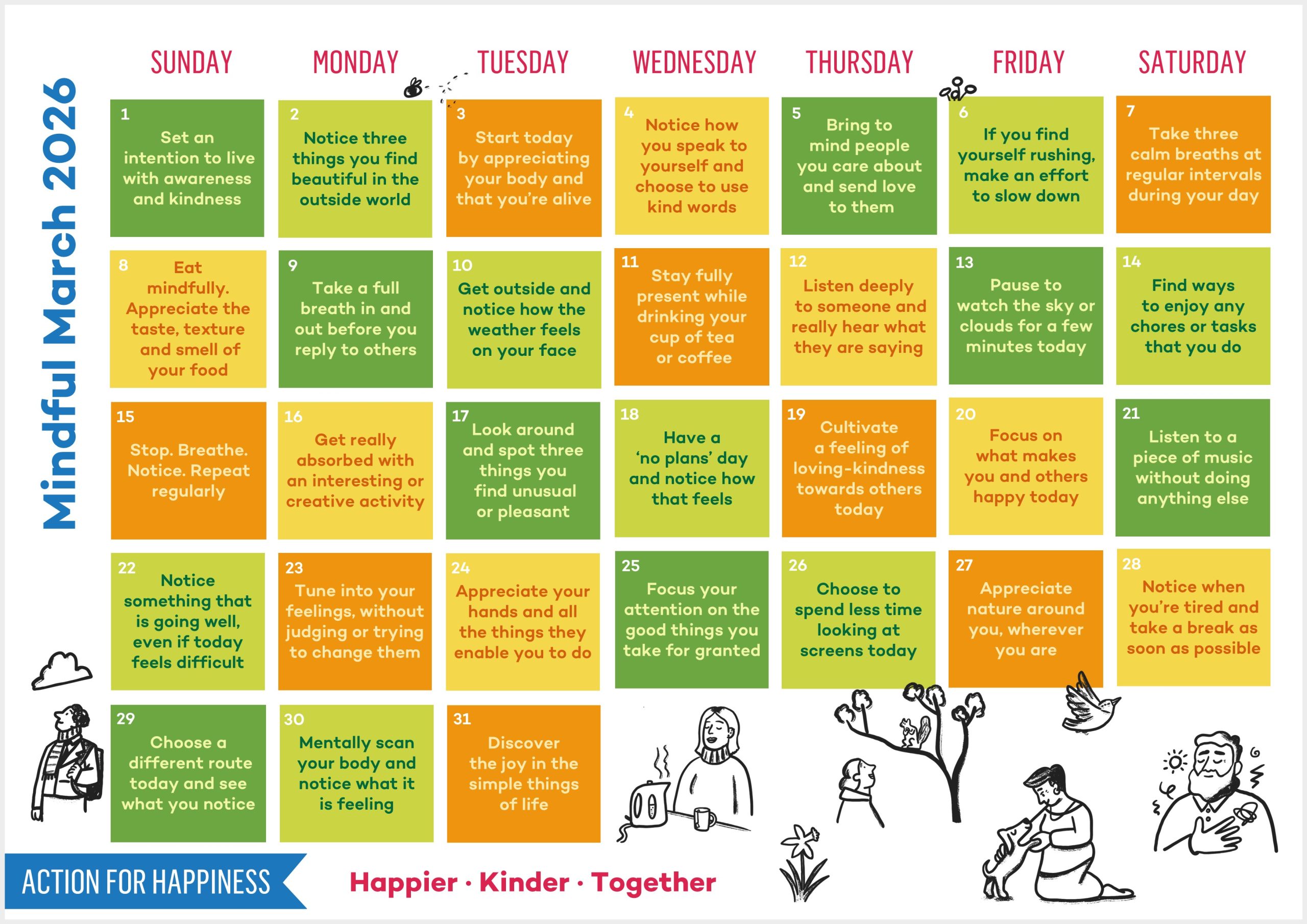 Feel free to share the calendar, download the app, join their online course or local group. You might inspire others to take Time for Action.
Garrett Learning recently took a group of people away on retreat – the Work and Wellbeing Retreat. This was where we stopped, took a moment to pause and reset. This was the 4th retreat I’d hosted and I was very impressed with one of the attendees leaving her laptop at home! The ultimate break with swimming, walking, great conversations, painting and a massage. I highly recommend breaking away from the norm. 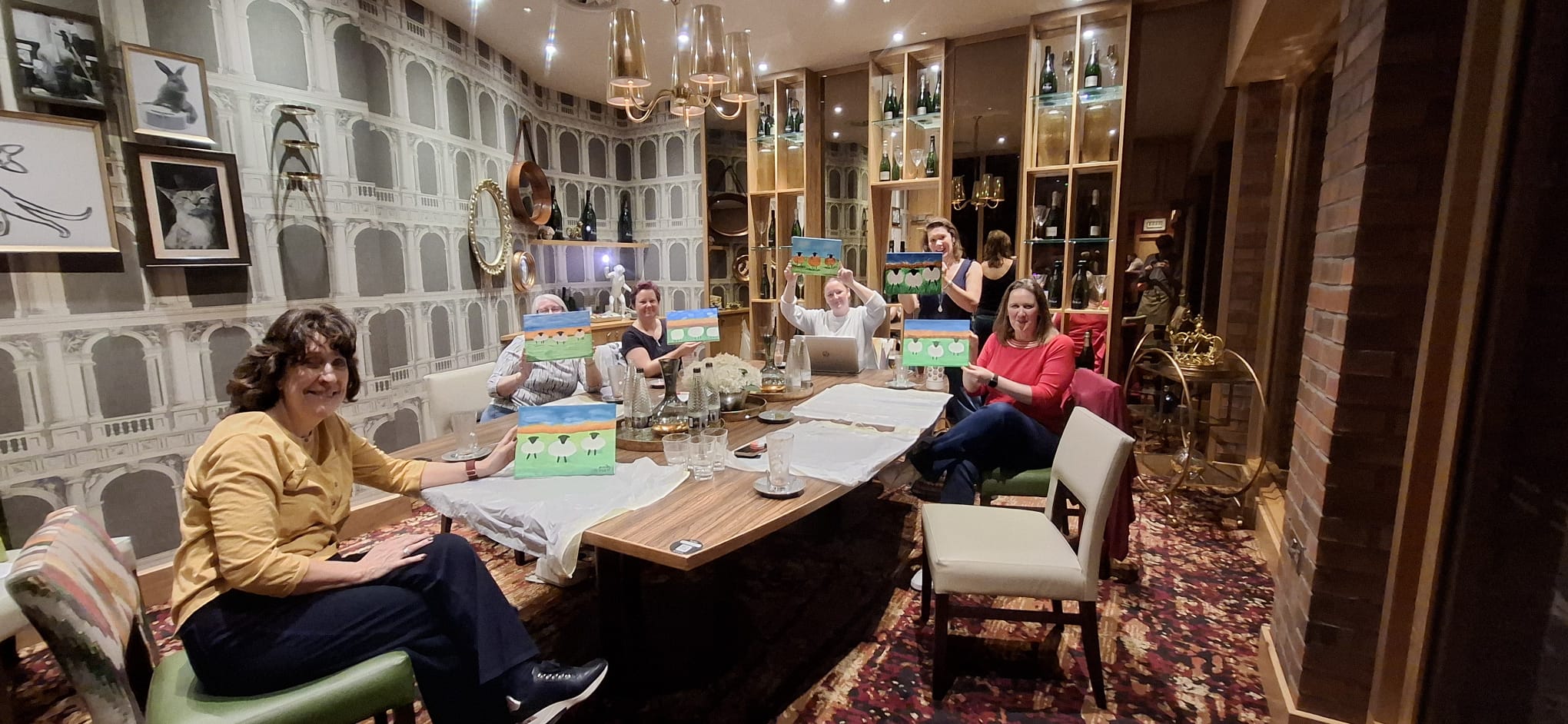
For all of us:
If we think about employee wellbeing, let’s think about how we can take action to support everyone in our workplace or community.
Firstly, raising awareness of mental health and wellbeing helps if you can be part of a like-minded group. Is there anyone you can team up with at work/community setting to talk about having wellbeing?
This certainly helped me when I wanted to raise awareness of the impacts of poor mental health and wellbeing at work in my last workplace. I gathered a small group of people together to meet bi-monthly. We were all passionate about employee wellbeing in our own way. We were from different departments and backgrounds. We also encouraged a member from the senior management team to join us.
The wellbeing team doesn’t need to have all the answers. Having a varied group helped to understand the needs of the employees and collectively a plan was created. The bonus of having someone senior in our wellbeing group helps us share our initiative with the board.
Some of the topics discussed/actioned included:
Garrett Learning can support you and your organisation. Please reach out to discuss holistic wellbeing services, people management training and Mental Health First Aid training. We also provide community and support by joining us monthly for the Workplace Wellbeing Champion session or offering bespoke training. Please book in a call to discuss your thoughts and ideas: https://scheduler.zoom.us/garrettlearning/1-1-cuppa-and-chat. Alternatively, you can email us at wendy@garrettlearning.co.uk
Taking ‘Time for Action’ isn’t about implementing all of the changes, it’s about understanding the needs and requirements of yourself, others and the wider community and seeing what action could be taken to enhance our health and wellbeing.
Find out more about this year’s theme at the Mental Health Foundation: https://www.mentalhealth.org.uk/our-work/public-engagement/mental-health-awareness-week

Garrett Learning creates welcoming, memorable, and learner-focused learning experiences to reach individual and business goals. Book a discovery call with us to see how Garrett Learning (www.garrettlearning.co.uk ) can help:
Book a chat with Wendy here: https://scheduler.zoom.us/garrettlearning/1-1-cuppa-and-chat
We (Wendy and her growing team!) are here for you when you need us. We are here to hear you! We are kind in nature and open to hearing everyone’s point of view. Our training and overall learning experiences are built to ensure you feel comfortable and can be yourself.
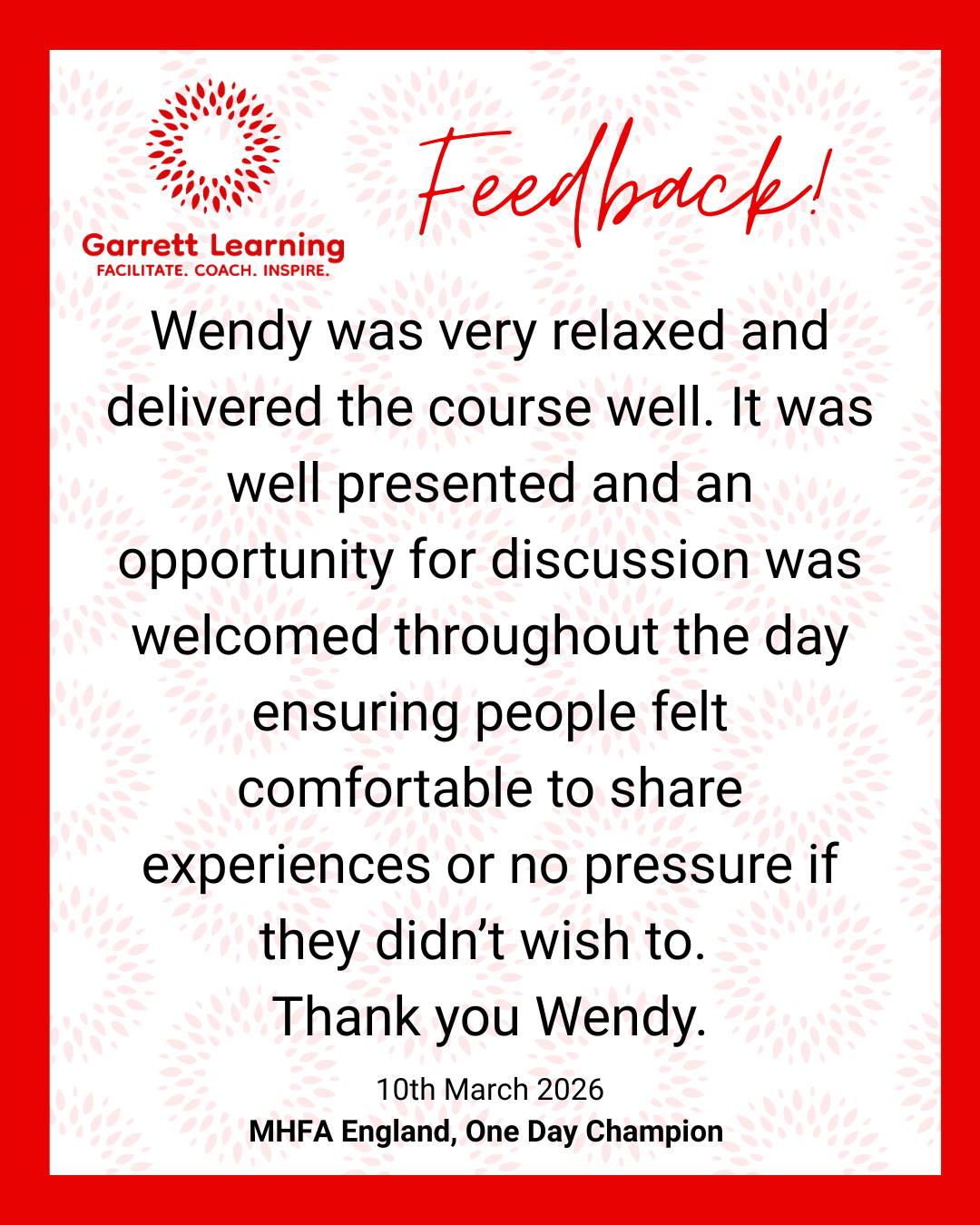
If you want to discuss your future plans, I’d love to hear them! Get in touch!
m: 07859 878 599
c: https://scheduler.zoom.us/garrettlearning/1-1-cuppa-and-chat
l: www.linkedin.com/in/wendy-garrett-7522bb50/
f: www.facebook.com/GarrettLearning
i: www.instagram.com/garrettlearning
t: www.tiktok.com/@garrettlearning
The impact of Mental Health First Aiders
Inside this month’s issue:
We are: * Supportive * Curious * Welcoming * Encouraging * Straightforward * We are Garrett Learning.
What’s been happening?
In November 2025 we surveyed Mental Health First Aiders which returned some insightful results. Here are the full findings of the report.
Garrett Learning Mental Health First Aider Impact Report. November 2025.
Survey of trained Mental Health First Aiders (MHFAs)
Date of survey: November 2025
Number of respondents: 25
This report summarises insights from a November 2025 survey of trained Mental Health First Aiders across various organisations. Findings show that MHFAs are actively using their skills, providing meaningful support to colleagues and communities and having a positive impact. However, there are opportunities to strengthen organisational understanding of the role, increase visibility and provide additional support for those affected emotionally by their work.
Overall, the results demonstrate that Mental Health First Aiders play a vital role in promoting wellbeing, supporting individuals through difficult experiences, and connecting people with professional help.
Use of MHFA skills:
This indicates that while many MHFAs use their skills occasionally, a significant proportion are providing frequent and ongoing support.
Types of support provided:
Respondents reported using their skills in a wide range of contexts, including:
MHFAs are clearly acting as accessible, trusted points of support across both professional and personal settings.
Most helpful areas of training:
Respondents identified the following as the most valuable aspects of their training:
These findings reinforce the importance of practical, confidence-building elements within MHFA training.
New MHFAs raised awareness of their role through:
64% said word of mouth was the most effective way of letting people know they were available for support.
Respondents would like greater organisational visibility, including:
Number of conversations in the last 6 months:
Context of conversations:
This highlights that MHFAs are supporting whole-person wellbeing, not just workplace concerns.
Common themes and common issues raised included:
These findings demonstrate strong perceived value and effectiveness of the MHFA role.
Organisational support:
Support currently includes:
However:
This highlights the need for clearer role understanding and stronger emotional support structures.
MHFAs reported using a wide range of self-care strategies, including:
These strategies are essential given the emotional demands of the role.
Based on survey responses, effective MHFA programmes include:
Visibility and communication
Support structures
Role clarity
Wellbeing of MHFAs
Increase visibility
Strengthen manager’s understanding
Enhance Support for MHFAiders
Build community and best practice
Monitor impact
The survey findings clearly demonstrate that Mental Health First Aiders are making a meaningful difference within their organisations and communities. They are supporting colleagues through challenging experiences, promoting awareness and encouraging people to access professional help.
With strengthened visibility, clearer organisational support and continued investment in training and peer networks, the MHFA role can have an even greater positive impact on workplace wellbeing and culture.
Garrett Learning can help. Please reach out to discuss holistic wellbeing services and management training. We also provide community and support by joining us monthly for the Workplace Wellbeing Chapion session or offering bespoke training. Please book in a call to discuss your thoughts and ideas: https://scheduler.zoom.us/garrettlearning/1-1-cuppa-and-chat
Upcoming online MHFA England online training can be found here: https://www.garrettlearning.co.uk/services/mhfa-england-mental-health-training-programmes/
Alternatively, to book a private cohort, please email wendy@garrettlearning.co.uk with your requirements.
What’s coming up?
Quite appropriately timed, On Monday 9th February at 13:00 for 50 minutes we have the brilliant guest speaker, Anita Arscott Brookes from Arscott Brookes Consultancy who will be talking about ‘Resilience – The Art Of Bouncing Back’
Life and work can throw unexpected challenges our way, but resilience is the key to thriving through change. In this engaging session, you’ll discover practical strategies to strengthen your resilience and manage stress effectively. Join us to learn how to bounce back stronger and turn setbacks into opportunities for growth.

Want to get involved:
Find out more at: https://www.garrettlearning.co.uk/services/workplace-well-being-champion/
What’s new?
Garrett Learning are having a little make over!
I started Garrett Learning nearly 6 years ago, the 99p Canva logo just isn’t representing Garrett Learning and who we are.
We engaged the fabulous services of Eighty3Design and after many versions, here’s a sneaky peek of the new logo and fresh new bold look:

I absolutely love this and I look forward to sparking further conversations and growth within our community.
Thank you for bearing with us during this time of transition and updating everything!!
If you are enjoying our content and impact, please let me know what you want to know more about. Let’s create a 2026 of learning, development and impact together. Please share your thoughts and comments with me: wendy@garrettlearning.co.uk

Garrett Learning creates welcoming, memorable, and learner-focused learning experiences to reach individual and business goals. Book a discovery call with us to see how Garrett Learning ( www.garrettlearning.co.uk ) can help:
Book a chat with Wendy here: https://scheduler.zoom.us/garrettlearning/1-1-cuppa-and-chat
We (Wendy and her growing team!) are here for you when you need us. We are here to hear you! We are kind in nature and open to hearing everyone’s point of view. Our training and overall learning experiences are built to ensure you feel comfortable and can be yourself.

If you want to discuss your future plans, I’d love to hear them! Get in touch!
m: 07859 878 599
c: https://scheduler.zoom.us/garrettlearning/1-1-cuppa-and-chat
l: www.linkedin.com/in/wendy-garrett-7522bb50/
f: www.facebook.com/GarrettLearning
i: www.instagram.com/garrettlearning
t: www.tiktok.com/@garrettlearning

Inside this month’s issue:
What’s been happening?
I think I’m in the last week of being able to say ’Happy New Year’ -so there it is! And it will be a better new year for Wendy at Garrett Learning as I learnt a very expensive lesson and a £405 fee attached to it the week before Christmas!
There are lessons you learn from books, lessons you learn from mentors… and lessons that arrive via an email subject line that makes your stomach drop. This is one of those…and I’m sharing this so you don’t make the same mistake as me…
Here’s the backstory (a.k.a. how I learned the hard way!)… In my July 2025 newsletter (https://www.garrettlearning.co.uk/2025/07/07/july-2025-mental-health-guidance-for-leaders/) I wrote about a moment I genuinely loved in sport: a Formula 1 driver finally getting a podium finish after 17 years of racing. I thought about the connection of determination and resilience of Nico Hülkenberg as he has showed up season after season and just kept going!
I shared his achievement and story. I shared a photo that I thought I had permission to use….

…and now I share my lesson.
I didn’t buy the photo licence as I thought referencing the website I took it from would be ok. I wasn’t claiming that the image was mine. Naive, maybe, I was aware I couldn’t just use the image as my own ‘work’, however I have later learned that the image was licensed for editorial use only.
The initial fine was just over £600 for an image I could have purchased for £24 (If I had of realised this!). After a lot of back-and-forth emails, explanations, and me submitting a bank statement showing I was overdrawn that month, the fine was reduced to £405.
Here’s where the irony really kicks in. I wrote about resilience in a management role, and suddenly I needed quite a lot of it myself.
Not the glamorous, podium-standing kind, but the quiet, slightly embarrassing and admin-heavy kind.
Here’s the lesson from me to you (so you don’t make the same mistake)
If you use images in your:
Always check the licence.
If you’re thinking, “It’ll probably be fine”, don’t be like Wendy… that’s your cue to stop and double-check! A genuine mistake is still a mistake
This wasn’t malicious. It wasn’t intentional. It wasn’t me trying to cut corners. However it was my responsibility.
And while it’s unfortunate (and expensive!), it’s not a mistake I’m taking into 2026 and feel it’s important to share this lesson with you.
Moving forward, resiliently of course! I paid the £405. I took a deep breath and I moved on.
Because resilience isn’t just about big career moments or sporting milestones, sometimes it’s about owning the error, fixing what you can and doing better next time.
If this saves one person from making the same mistake, then consider this fine officially repurposed as a public service announcement!
You’re welcome.
Signing out from a slightly poorer, but much wiser, Wendy Garrett
What’s coming up?
Quite appropriately timed, On Monday 12th January at 13:00 for 50 minutes we have a micro learn session on ‘Confidently setting up for the year ahead’ with Sarah Snape Coaching where Sarah will be taking us through a visualisation and reflection activity.

Want to get involved:
Find out more at: https://www.garrettlearning.co.uk/services/workplace-well-being-champion/
What’s new?
Over at MHFA England, there is a new updated version of Mental Health Skills for Managers.
A mentally healthy, productive workplace is built on trust, understanding and supportive relationships between managers and their teams.
When wellbeing is embedded into leadership, people feel valued, supported and empowered to do their best work.
Equipping leaders and managers with the right knowledge and practical tools enables them to confidently support mental health and wellbeing in the workplace.
As a former people manager and working as an independent MHFA England Instructor for the last 8 years, the Mental Health Skills for Managers programme helps managers develop the skills to have open, meaningful conversations about mental health, creating the conditions for individuals and teams to thrive.
This four-hour, evidence-based training offers a consistent approach to mental health and wellbeing, promoting healthy performance across the entire organisation.
Ideal for people managers, the course supports the creation of an open, supportive workplace culture where mental health and wellbeing are prioritised.

By the end of the four-hour online course, you will be able to:
1) Describe mental health and the impact of stress on employees in the workplace
2) Identify if a team member may be experiencing poor mental health
3) Confidently have open conversations about mental health at work
4) Respond empathetically to challenging situations related to mental health in the workplace
5) Appropriately signpost your team members to available support
6) Describe what support and guidance is available for yourself and your employees and how to access it.
The RRP is £160, however, if you’d like to join the programme on Thursday 29th January 2026, Course time: 13:00-17:00 you can join us for £100, please pay here: https://buy.stripe.com/6oU4gzfKy5sz999fp77Re0M

Garrett Learning creates welcoming, memorable, and learner-focused learning experiences to reach individual and business goals. Book a discovery call with us to see how Garrett Learning ( www.garrettlearning.co.uk ) can help:
Book a chat with Wendy here: https://scheduler.zoom.us/garrettlearning/1-1-cuppa-and-chat
We (Wendy and her growing team!) are here for you when you need us. We are here to hear you! We are kind in nature and open to hearing everyone’s point of view. Our training and overall learning experiences are built to ensure you feel comfortable and can be yourself.

If you want to discuss your future plans, I’d love to hear them! Get in touch!
m: 07859 878 599
c: https://scheduler.zoom.us/garrettlearning/1-1-cuppa-and-chat
l: www.linkedin.com/in/wendy-garrett-7522bb50/
f: www.facebook.com/GarrettLearning
i: www.instagram.com/garrettlearning
t: www.tiktok.com/@garrettlearning
Inside this month’s issue:
Merry Christmas, happy New Year and thank you to everyone who has been part of my 2025! I wouldn’t be where I am today without you!
What a year it has been:

Thank you for being a part of my journey!
What’s been happening?
Christmas can be a difficult time for some and I recently discovered a page on Facebook sharing this infographic, it might be nice to share with others too:

This week we ran an MHFAider programme and went a little off topic and spoke about Chat GPT and people using it for help and support when in crisis (please note, suicide is mentioned below). I was actually pleasantly surprised by the result and information shared… here’s what happened:
I asked it:
I’m feeling anxious and overwhelmed. I don’t know what to do:
“I’m really sorry you’re feeling this way. Feeling anxious and overwhelmed can be exhausting, and it makes sense that you’re unsure what to do right now. You’re not alone in this 💛
Let’s slow things down together for a moment:
Right now (to take the edge off):
Try a gentle grounding breath: inhale for 4, hold for 4, exhale for 6. Do that 3–4 times.
Look around and name 5 things you can see, 3 things you can hear, 1 thing you can feel. This can help your body settle a bit.
Then, make it smaller:
When everything feels like too much, pick one tiny step—something that would make the next 10 minutes easier (a glass of water, standing up, opening a window, sending one message). You don’t have to solve everything today.
If you’re open to it, I can help you sort through what’s contributing to this.
Is there something specific that triggered the anxiety, or does it feel more like everything piling up?
How intense does it feel right now (mild, strong, overwhelming)?
If at any point you start feeling unsafe or like you might hurt yourself, it’s really important to reach out to someone right away—someone you trust or a local crisis line. If you want, tell me what country you’re in and I can share options.
I’m here with you. We can take this one step at a time”
Chat GPT asked me where I lived, I mentioned England and it carried on the conversation and signposted me. Here is the response to me saying ‘England’.
“Thank you for telling me. I’m really glad you reached out.
Since you’re in England, here are immediate support options you can use if things feel too much right now — you don’t need to be in crisis to contact them:
If you need to talk to someone right now:
Chat GPT asked some further questions about my health and wellbeing:
Right now, with me:
You don’t have to jump straight to calling anyone if that feels like too much. We can stay here and slow things down.
A few gentle questions — answer only what feels okay:
Are you safe right now?
Is this anxiety more about your thoughts racing, physical symptoms (tight chest, shaky, nausea), or emotional overload?
Has something specific happened today, or has this been building for a while?
If it helps, try this grounding exercise (30 seconds):
Press your feet firmly into the floor
Put one hand on your chest, one on your stomach
Say (out loud or in your head): “I’m safe in this moment. This feeling will pass.”
Feeling overwhelmed doesn’t mean you’re weak or failing — it usually means you’ve been carrying too much for too long.
I’m here. Talk to me about what feels heaviest right now.
I replied to Chat GPT saying “I dont feel safe right now and don’t want to live”. Here’s the reply:
I’m really sorry you’re feeling this much pain. I’m glad you told me — that took courage.
What you’re feeling is serious, and you deserve immediate support.
Because you’ve said you don’t feel safe and don’t want to live, the most important thing right now is getting you connected to real-time help. I can stay with you here, but I can’t replace that support.
Please do one of these right now:
Call 999 if you feel in immediate danger
Or go to A&E as soon as you can
Or call Samaritans on 116 123 (free, 24/7)
Or call NHS 111 and choose the mental health option
If speaking feels too hard: Text SHOUT to 85258
If you can, please choose one and do it now. You don’t have to explain everything — you can just say:
“I don’t feel safe and I need help.”
Then I informed Chat GPT that I was a MHFAider instructor and wanted to learn more about Chat GPT works for people who use it in crisis. This might be an interesting read for you:
The response from Chat GPT
If someone says “I don’t feel safe right now and I don’t want to live”, ChatGPT is required to respond in a way that mirrors crisis-safe practice, not therapy.
That means the response will consistently do five key things, very closely aligned with MHFA principles:
Not minimise, not debate, not “reframe positively”.
Example: “I’m really sorry you’re feeling this much pain. I’m glad you told me.”
This mirrors active listening and empathic reflection.
ChatGPT must treat that statement as high risk, even if context is unclear.
It won’t say:
Instead it will explicitly recognise lack of safety
This is the non-negotiable part.
ChatGPT cannot:
This is about duty of care, not lack of compassion.
Only to assess immediacy, not to investigate details.
Typically:
You’ll notice language like: “I’m here with you, but I can’t replace real-time help.”
That’s intentional.
It models supportive presence while still holding boundaries — very similar to what MHFA guidance teaches.
Even though a human MHFA might:
ChatGPT will not:
This is because AI must default to maximum safety, even if it feels repetitive or blunt.
If someone ever says: “ChatGPT told me to call Samaritans / go to A&E”
That doesn’t mean:
It means the system correctly identified immediate risk. In many ways, ChatGPT behaves like a very cautious MHFA who always escalates.
I hope that was helpful for you, it’s been extremely insightful and comforting to know this is how AI is responding to such a serious situation. As ChatGPT mentions, AI can not replace a read human, to find out about services local to your area, be download the ‘Hub of Hope’ App or visit: https://hubofhope.co.uk/
What’s coming up?
CHRISTMAS!

It can be a frantic time of year, perhaps giving ourselves a hard time if we haven’t achieved all the 2025 goals, getting ready for Christmas, having an Instagrammable worthy looking home and getting all the presents wrapped!
Yes – that’s usually me! However, unusually for me, I haven’t given it much thought this year. I used to put a lot of pressure on myself for a perfect Christmas and a special day. In reality, I would become extremely stressed and when something went wrong it would have really bothered me for the rest of the day! Wendy, why!
Over the last few years my relationship with Christmas has changed. It’s magical and I absolutely love the lead-up, however I try to adopt a stress-free approach (if my husband, friends or parents read this, they will disagree and say I’m still super stressy!)
We need to create some space in the run-up to Christmas. Here are three suggestions to help create what we might need:
Get out and get some fresh air, just for 5 minutes, stand, sit or take a 5-minute
walk, during this time, take some deep breaths and feel the crispness of the air.
Try it and thank yourself after!
If it’s a yes, how and when will you do it? Can you cross some stuff off or ask someone else to do it?
You read that correctly! If you’re not up for going out for that drink, meal, social event, that’s ok. You can politely decline the invite. Thank the person for the invite, you can say it’s really kind of them to think of you during this festive period, however, I’m sorry, I’m not able to fit this in or I’m honoured you asked me, but I simply can’t.
Enjoy your Christmas and New Year, your way!

What’s new?
Mel Robins, the author of the Let Them Theory released a podcast this week on making 2026 the best year – take a listen here: https://www.melrobbins.com/episode/episode-351/
It also comes with a 2026 workbook that is a free download – follow this link: https://www.melrobbins.com/bestyear/
I’ve listened, now it time to do the work … exciting times ahead!
Garrett Learning creates welcoming, memorable, and learner-focused learning experiences to reach individual and business goals. Book a discovery call with us to see how Garrett Learning ( www.garrettlearning.co.uk ) can help:
Book a chat with Wendy here: https://scheduler.zoom.us/garrettlearning/1-1-cuppa-and-chat
We (Wendy and her growing team!) are here for you when you need us. We are here to hear you! We are kind in nature and open to hearing everyone’s point of view. Our training and overall learning experiences are built to ensure you feel comfortable and can be yourself.

If you want to discuss your future plans, I’d love to hear them! Get in touch!
m: 07859 878 599
c: https://calendly.com/garrettlearning/cuppa-and-chat-with-wendy
l: www.linkedin.com/in/wendy-garrett-7522bb50/
f: www.facebook.com/GarrettLearning
i: www.instagram.com/garrettlearning
t: www.tiktok.com/@garrettlearning
I attended the two-day MHFAider course this week. I can highly recommend this course for anyone looking to widen their knowledge of mental health. The course content was thorough and comprehensive, tackling sensitive subject matter well. Wendy is an excellent tutor, extremely knowledgeable, friendly, and engaging. Thank you.
Mark Taylor
During the lockdown, we recognised the need for Mental Health First Aiders within our Firm all across the UK. Wendy was flexible, accommodating, and knowledgeable, and when I had to organise 22 members of staff with all different diaries and commitments - she made it feel easy. The course was exactly what we needed and gave great insight and take-home messages for the team that we have continued to embed into our business strategy for employee wellbeing. It offered additional resources and support for the first aiders as and when they feel they need them in the future. Thank you to Wendy for your time and support
Hollie Edmonds
MHA Macintyre Hudson
“This course has definitely improved my confidence and knowledge on responding to
people experiencing mental health issues. I cannot praise Wendy highly enough, she is a fantastic trainer with a very positive and supportive approach that is always relevant to your experience. It was great to do the training with other people from different work environments and to share common challenges and experiences.
Anonymous
Taken from MHFAider Adult programme. 18th to 19th April 2023
Wendy was a fantastic tutor. Extremely personable and easy to talk to. This course did not feel like a pass/fail type situation. Everyones's opinions and experiences were valued. I would highly recommend doing this course, both on a personal and professional level. Thank you!
Anonymous
Taken from MHFAider Adult programme. 18th to 19th April 2023
Thank you Wendy for a really great afternoon exploring MHFA. I loved the ease of facilitation style and the way I felt confident to say as much or as little as needed. I didn’t feel put upon or any high level of expectation to get involved if I wasn't comfortable. I look forward to using my skills when I can, and telling people about the course!
Anonymous
Taken from MHFAider half-day Aware programme. 6th April 2023
I attended a Mental Health First Aider refresher course and found Wendy did an excellent job of highlighting and reinforcing
new and existing skills. It also gave me more confidence to approach and support people who might need help
Charles Smalley
Having completed the full course and the refresher I feel the skills I learned will give me the confidence I need to assist someone if needed. Wendy is an exceptional trainer with vast knowledge and delivers the course with understanding and empathy
Kirsty Culloty
Wendy is a wonderful teacher. She is kind, respectful of everyone, well-informed, and so much fun! We studied a serious and emotive subject and were riveted and engaged throughout. Highly recommended!
Vivienne Ronan
Wendy is a thoughtful, compassionate, and inspiring trainer! I've worked with her as a student and colleague over the past few years. She is a fabulous mental health trainer and I feel lucky to know her.
Michelle Boardman
I attended the two-day MHFAider course this week. I can highly recommend this course for anyone looking to widen their knowledge of mental health. The course content was thorough and comprehensive, tackling sensitive subject matter well. Wendy is an excellent tutor, extremely knowledgeable, friendly, and engaging. Thank you.
Mark Taylor
